Metal blanking: what it is, how it works, and how it differs from other processes
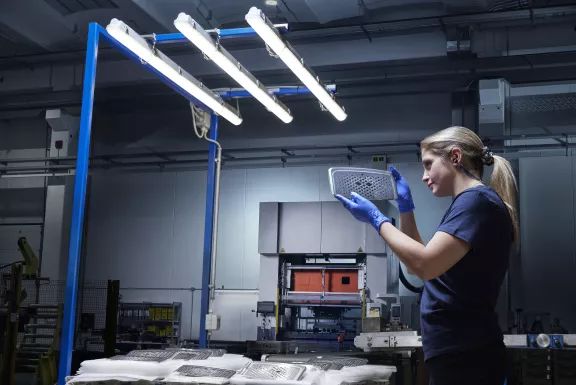
Metal blanking is a cold cutting process that is important in many sectors - from electromechanics, energy, kitchen robotics, vending, professional lighting, and gas distribution - and allows the production of parts with clean and repeatable profiles from coiled strip or flat sheets.
This Minifaber’s guide to metal blanking explains:
- what metal blanking is?
- when shearing is preferable to other cutting methods?
- which metals can undergo this process?
- wich are the benefits of shearing in terms of productivity and quality standards?
What is blanking (and how does it differ from punching)?
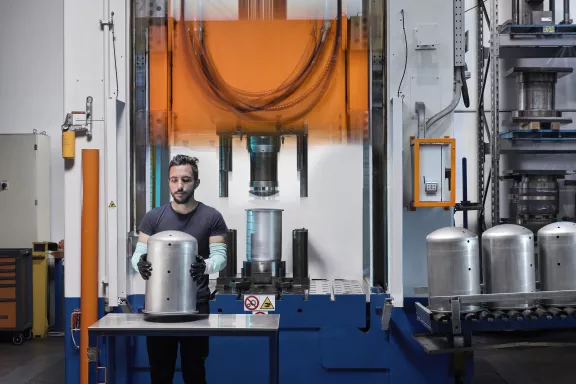
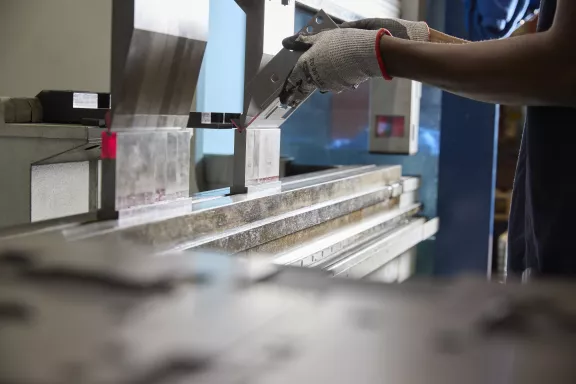
Starting from the definition of metal blanking, it should be emphasized that this is a cold working process that allows a piece to be separated from the raw material by means of shearing between the punch and the die, the active parts of the mold, which are pushed against each other by a press.
The movement of the punch relative to the die, separated by a limited and functional space called clearance, produces the shearing of the material.
In this process, dies dedicated to the shape to be produced are constructed and used under mechanical presses or servo presses. The raw material used is in the form of rolls of strips or bands and squares. The flat sheared shape is called blanking.
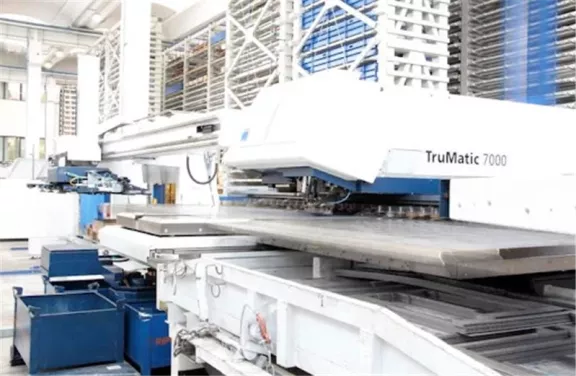
In the punching process, standardized tools consisting of a die, punch, and sheet metal press are used under special machines called punching machines. At Minifaber, punching machines are combined with laser cutting to simultaneously obtain the advantages of both processes.
With this process, the raw material used is flat sheet metal. In the case of laser cutting, the initial pre-hole made to perform the cut is called piercing.
Understanding the difference between blanking and punching is important because in both cases the physical mechanism is the same: the punch penetrates the sheet metal until it triggers a clean cut zone followed by a controlled fracture along the edge of the die.
Blanking leaves four typical marks on the edge: a small rounding at the entry point, a smooth cut zone, a fracture zone, and a burr at the exit point, the height of which depends not only on the type of material and thickness, but also on the precision of the tools.
The quality of the material used to make the blanking tools and the precision of the machining are essential for obtaining a good cut and ensuring the durability of the tools themselves.
Difference between industrial metal blanking and other cutting methods
The difference between blanking and other thermal or mechanical cutting technologies without a mold lies in precision, but not only.
With shearing, once the die has been designed and fine-tuned, each press stroke repeats the same sequence, which means that you can achieve extremely high dimensional repeatability, minimum cycle times, and unit costs that decrease as volumes increase.
The advantage of blanking is that it is the best possible technique if you need to produce many identical parts, with repeatable tolerances and multiple steps combined in the same cycle. It is the technology that offers the best balance between quality, time, and unit cost.
Blanking dies: types
In the metal blanking process, the choice of die is the first factor that determines quality, productivity, and cost per part. However, it should be noted that not all dies for metal blanking are the same.
In terms of function, they can be divided into:
- simple dies
- compound dies
- step dies for progressive blanking
- transfer dies where the piece is immediately separated from the base material
Understanding the difference between the various types allows you to set up the process correctly.
Simple, compound, progressive, transfer dies: how they work
The first thing to note is that the simple die performs a single operation with each press stroke, for example, only blanking or only bending. This is the most straightforward solution, useful when volumes do not justify greater complexity, or when you want to separate the processing stages for logistical or operational reasons, or when the piece to be stamped has very high aesthetic requirements.
In the case of blanking, the starting material is a scrap, strip, or square; in the case of bending or other stamping, it could be a piece that has already been blanked. In this case, we refer to a follow-up die.
The compound die, on the other hand, combines several operations in the same press stroke, for example, blanking, bending, and stamping.
Using this type of die ensures the geometric relationship between multiple entities of the figure, which reduces processing time.
The step die falls within the scope of progressive blanking and is also known as a progressive die. In this case, the sheet metal arrives in the form of rolls or coils. An automatic press feeding line performs the functions of unwinding the strip, straightening it from the curvature of the roll, lubricating it, and finally feeding it under the press at a constant speed.
The strip advances through a sequence of stations, and at each station one or more operations are performed - such as shearing, bending, shallow drawing, or coining - until a finished part is obtained at the output. In the step die, pilot holes ensure the correct pitch. The study of this sequence of operations, called a strip, pass, or list, minimizes scrap. This is undoubtedly the preferred solution when it comes to large series of parts to be produced, as it combines dimensional repeatability, minimum cycle times, and the integration of multiple phases in the same station. In the progressive die, the part remains attached to the base material and is only finally released in the last operation
The transfer die, on the other hand, can be imagined as a finite sequence of stations, where the piece of material is immediately separated from the base material and taken to the subsequent stations by an auxiliary mechatronic device called a transfer. This type of die is useful for medium-depth deep-drawn parts where the starting piece is immediately released in the first station with a fixed guide die made with a head/tail shape.
It should be noted that each blanking die is a miniature mechatronic system. The various sensors - including those for part presence, strip breakage, and overload - communicate with the press and prevent damage and downtime. The strip feeding system is interfaced with the press movement.
The punch and die are made of very fine-grained tool steel to limit wear and chipping. During mechanical processing, heat treatments such as hardening and tempering are performed to increase hardness without compromising toughness. At the end of the construction cycle, the punch and dies are polished to a mirror finish and coated with PVD treatments consisting of titanium aluminum nitrides and more.
Punches and dies, together with the other components of the mold, are suitably mounted on an upper and lower mold holder, which are in turn connected by a highly precise guide system made with columns and ball bushings.
In molds with sheet metal pressers, pressure plates are used to hold the sheet metal in place while shearing, deep drawing, or bending operations are performed. The sheet metal press is loaded by elastic elements such as rubber, springs, and nitrogen cylinders. The pilot punches have the function of centering the strip in pre-cut holes and ensuring the correct movement of the strip within the individual stations of the mold. Adequate and optimized lubrication reduces friction, seizing, and wear, improving the quality and life of the mold.
The quality of the cut edge and the stability of the process depend on a few countless variables that must be managed in the best possible way to ensure a flawless result.
The material to be stamped and punched (steel, stainless steel, aluminum, brass, copper), the thickness, and the perimeter cut per stroke all affect the force required and therefore the tonnage of the press.
The punch/die clearance is also a key parameter, because if it is too tight there is greater wear, and if it is too wide there is increased burring and inclined fracture.
Shearing dies work with a wide range of materials - from steel to stainless steel, aluminum, brass, copper, and titanium - but they can also handle pre-galvanized or pre-painted sheet metal, although in this case precautions must be taken to protect the finish.
What is metal blanking used for and in which sectors
Metal blanking is used to quickly obtain shaped pieces from sheet metal (or to create holes/openings), with repeatable tolerances and low unit costs for series production.
Metal shearing is one of the leading services offered by the Minifaber team in the field of metalworking.
We work for the following sectors:
- electromechanical
- medical
- robotics
- lighting technology
- household appliances
- vending
- gas distribution