Hydroforming: technology for complex metal shapes
In the field of cold metal working, hydroforming stands out as one of the most innovative technologies for creating complex, three-dimensional, high-precision shapes.
Although not yet as widespread as traditional stamping, the technique is becoming increasingly popular in contexts where geometric quality, material stability, and process sustainability are decisive factors.
However, it is important not to think that hydroforming is simply an alternative to conventional deep drawing. In fact, it is a different approach to metal deformation, as in this case hydraulic pressure is used to achieve results that are difficult to achieve with more traditional technologies.
What is hydroforming and what makes it different from deep drawing?
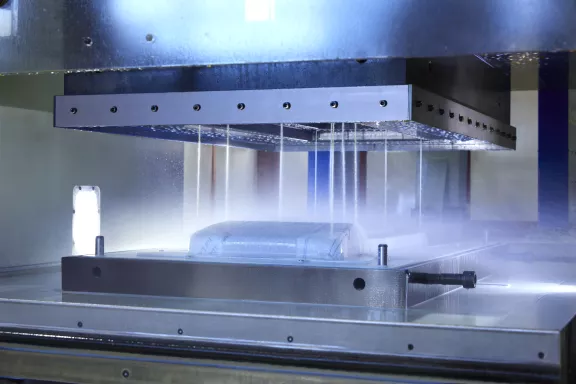
Hydroforming is a cold forming technique that uses pressurized fluid to shape a flat sheet metal inside a mold.
Unlike conventional deep drawing, where deformation is generated by a rigid punch, here it is the fluid itself that pushes the material against the die, distributing the stress evenly.
This principle allows for:
- more complex geometries in a single pass,
- more consistent thicknesses across the entire surface,
- a significant reduction in internal stresses and springback.
The result is a more stable component that is more faithful to the design and often better from an aesthetic point of view.
The main advantages of hydroforming
The growing interest in hydroforming is linked to a number of technical and production advantages that make it particularly suitable for certain industrial contexts.
Greater precision and stability of the part
The use of pressurized fluid allows for more uniform deformation than traditional techniques. This results in:
- less unwanted deformation,
- more accurate control of tolerances,
- reduction of material springback.
In many cases, results that would require multiple steps with conventional deep drawing can be achieved with a single hydroforming cycle.
Faster mold production times
Hydroforming uses simpler molds: a single die, a support surface, and a fluid sealing system. This configuration allows for:
- lower mold production costs,
- faster delivery times for the first samples,
- greater flexibility in the product development phase.
A more sustainable process
Hydroforming also stands out for its environmental profile. Unlike conventional deep drawing, it does not require the use of structured lubricating oils containing potentially harmful substances such as chlorine or sulfur derivatives.
The process generally uses an emulsifiable oil, which is easily removable after forming, reducing the need for intensive washing, chemical detergents, and high energy consumption. This makes hydroforming a more consistent choice with industrial policies geared towards sustainability.
Adaptability to different materials
Another strength is its versatility in terms of materials. Hydroforming can be applied to a wide range of metals commonly used in the cold working industry, including:
- stainless steel,
- ferrous materials,
- pre-galvanized and pre-painted materials,
- aluminum,
- copper.
This adaptability allows the same process logic to be used in very different sectors and applications.
How the sheet metal hydroforming process works
The steps involved in the sheet metal hydroforming process are well defined to ensure repeatable, high-quality results.
The flat sheet metal is initially positioned on the mold surface. Next, the die—mounted on the moving surface of the press—clamps the sheet metal, creating a closed chamber. At this point, fluid is pressurized through a hole in the mold surface and beneath the sheet metal. The fluid pressure inflates the sheet metal until it is progressively pushed against the walls of the die, thus obtaining the desired shape.
Once forming is complete, the fluid is discharged, the press opens, and the piece can be removed. The process, despite its apparent simplicity, requires very precise control of the pressure parameters, both of the fluid that forms the piece and of the oil in the press cylinder that must keep the mold closed. At the same time, the closing force must allow the material to flow into the die to avoid breakage and pinching.
As with conventional deep drawing, hydroforming also requires careful control of the chemical and mechanical characteristics of the material.
Sheet metal hydroforming: when it really pays off
Sheet metal hydroforming is particularly advantageous when:
- complex three-dimensional shapes are required,
- it is important to maintain a uniform thickness,
- internal stresses in the material and springback must be reduced
- the mold must be made quickly and at low cost
- the aesthetic appearance of the part is important,
- subsequent finishing operations are to be reduced
This solution becomes extremely competitive when the quality of the final result is an essential requirement.
Hydroforming of the most commonly used materials
Hydroforming of stainless steel
Stainless steel is one of the materials that benefits most from hydroforming. Hydraulic pressure does not cause scratches or marks on the surface, preserving the aesthetics of the material and reducing surface defects.
For this reason, stainless steel hydroforming is widely used in sectors such as electromechanics, electromedical, household appliances, chemicals, and pharmaceuticals, where high standards of quality and cleanliness are required.
Hydroforming of aluminum
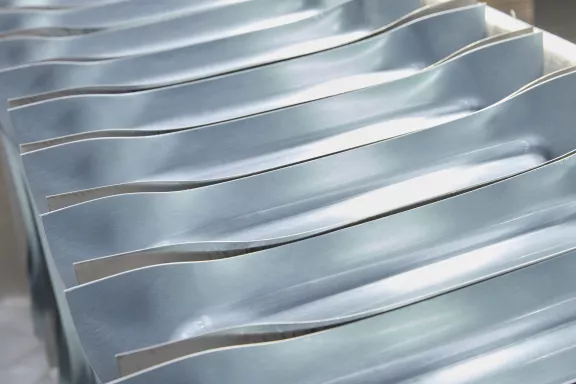
Aluminum is also particularly well suited to this process. Hydroforming allows for the production of lightweight yet strong components with complex geometries and high-quality surfaces.
Sectors such as electromedical, electromechanical, professional lighting, and aerospace use aluminum hydroforming to manufacture components that must combine lightness, precision, and structural reliability.
Hydroforming as part of an advanced industrial approach
Beyond individual processing, hydroforming is an example of how advanced forming technologies can be integrated into more efficient production models. From a lean manufacturing perspective, concentrating multiple processing stages in the same department reduces unnecessary handling, waiting times, and the risk of damage to semi-finished products.
When integrated with subsequent processes—such as 3D laser cutting for the final definition of the geometry—hydroforming becomes an extremely powerful tool for the production of complex and customized components.