Quality and Inspection in Sheet Metal Fabrication: Standards, Processes, and Reliability
In the sheet metal fabrication industry, quality is the result of a structured process that begins with project analysis and continues through every stage of production: material selection, mechanical processing, bending, stamping, assembly, dimensional inspections, and verification of the finished component’s compliance.
To establish an effective quality control process in sheet metal fabrication, inspection alone is not enough. What is needed is a carefully designed system aimed at ensuring precision, repeatability, and long-term reliability.
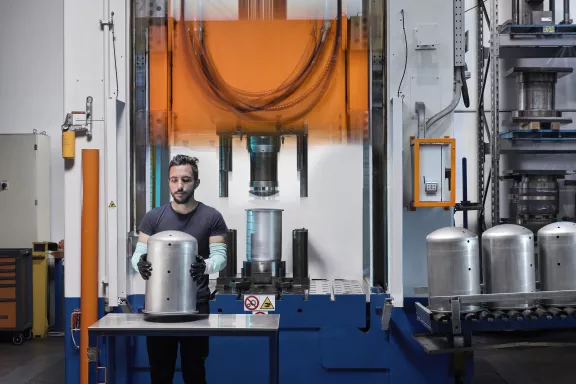
In cold forming operations, particularly stamping, bending, and deep drawing, sheet metal undergoes a series of metallurgical and physical transformations. The metal is subjected to stress and permanent deformation, allowing it to achieve the required shape. However, this also results in work hardening, which reduces the material’s remaining plastic deformation capacity. When the component is released from the die, springback may occur. At that stage, the metal tends to release internal stresses, which can affect dimensions and tolerances.
This behavior is especially evident in deep drawing operations, where thickness variations are unavoidable.
Welding must also be considered carefully, as it requires both solid hands-on experience and in-depth technical knowledge. In this type of process, it is essential to understand and control both the materials and the different welding methods involved, and above all, to anticipate and manage thermal cycles. It is also important to stay up to date with the specific standards that apply to the sector.
Managing all of these aspects requires engineering expertise and practical production experience. For this reason, relying on specialized partners such as Minifaber provides an additional guarantee of control over the entire manufacturing cycle.
For a company that needs to manufacture metal components, choosing a production partner capable of managing quality in an integrated way means reducing the risk of nonconformities, avoiding rework, optimizing time and costs, and obtaining parts that are consistent with the required technical specifications.
For Minifaber, the added value lies in supporting the customer throughout every stage of the process, from the initial technical assessment to the production of the finished component. Thanks to an approach focused on process control, certified quality, and close collaboration with the customer, the company is able to provide reliable solutions for sheet metal fabrication, assembled components, and custom industrial production.
Quality Control in Sheet Metal Fabrication: What It Means
Quality control in sheet metal fabrication includes all the activities required to verify that the manufactured component complies with the technical drawing, the required tolerances, and the final function for which it was designed, while also ensuring that the entire process remains under control.
To achieve this, SPC techniques, or Statistical Process Control, must be implemented with the goal of preventing defects and scrap by acting on the process before it becomes unstable.
SPC techniques include mathematical methods and tools used in quality control to monitor, analyze, and improve production processes in real time. This makes it possible to collect and analyze data directly from the manufacturing process and, as a result, distinguish between natural variation inherent to the system and abnormal variation caused by specific factors. In this way, the process can be stabilized.
In a well-organized manufacturing process, quality is monitored throughout the entire workflow through checks, procedures, intermediate inspections, and monitoring activities.
This approach makes it possible to identify potential critical issues before they become more complex problems to manage. A nonconformity detected at an advanced stage may lead to scrap, rework, delays, and additional costs.
In sheet metal fabrication, this aspect is particularly important because each operation can influence the final geometry of the part. Every phase must be managed consistently, taking into account the material’s characteristics, dimensional tolerances, and application requirements.
Why Quality in Sheet Metal Fabrication Starts with the Project
The quality of a metal component begins during the design and technical analysis phase.
A drawing may be formally correct, but it is not always optimized for actual sheet metal fabrication. Dimensions, bend radii, thicknesses, tolerances, holes or slots positioned too close to bends or edges, welds, and assembly methods must also be evaluated from a manufacturability standpoint.
For this reason, working with the manufacturer from the earliest stages is essential. Minifaber supports customers in project analysis by verifying the consistency between technical specifications, selected material, production process, and expected result.
This makes it possible to identify potential issues early, optimize the design, assess the most suitable technology, and define realistic, functional tolerances. As a result, the risk of rework is reduced and industrialization becomes more efficient.
Quality is not only about inspection; it is also about prevention. A project that is properly evaluated from the start makes it possible to produce components that are more reliable, more consistent with the final application, and more sustainable from a manufacturing standpoint.
Dimensional Inspection of Metals: Dimensions, Tolerances, and Compliance
Dimensional inspection of metals is an essential part of quality control. Its purpose is to verify that the actual dimensions of the component comply with the dimensions and tolerances specified in the technical drawing.
In sheet metal fabrication, dimensional and geometric inspections may involve several features, including:
length and width of the part;
diameters of holes and slots;
center-to-center distances;
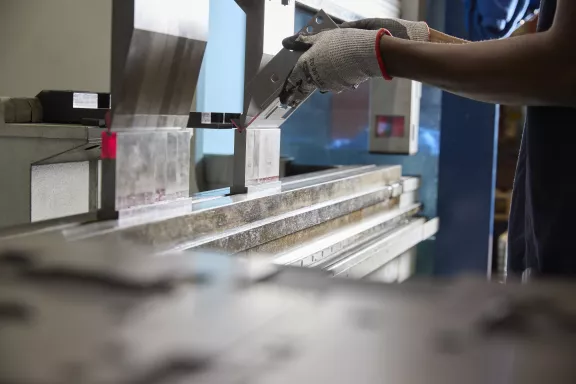
bend angles;
bend radii;
flatness;
parallelism and perpendicularity;
roundness and coaxiality;
runout;
hole positioning;
mating dimensions;
thicknesses;
overall dimensions;
correct alignment between multiple components.
These inspections are especially important when the part must be assembled with other elements, integrated into a more complex system, or meet precise functional requirements.
Even a small dimensional variation in a critical measurement can compromise assembly, create interference, cause misalignment, or reduce the functionality of the component. For this reason, it is essential to distinguish between functional dimensions, which require closer control, and less critical dimensions, which may allow wider tolerances without compromising the final result.
The Quality Assessment Process for Mechanical Operations
In the industrial sector, the quality of mechanical operations must be supported by an organized, documented, and verifiable process.
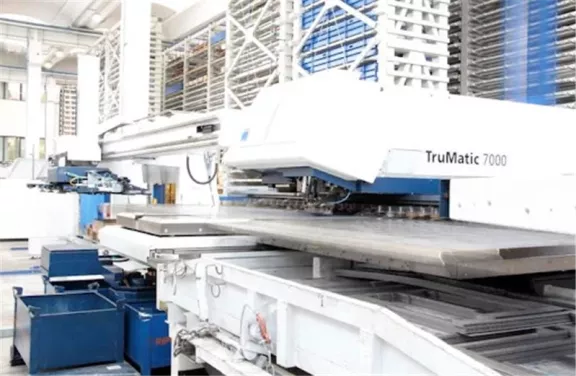
This is even more important when sheet metal fabrication includes several integrated phases, such as cutting, bending, stamping, welding, assembly, possible finishing operations, and final assembly. Each step can affect the component and must therefore be managed in a coordinated way.
An effective quality process verifies that the technical drawing has been interpreted correctly, that specifications and the production cycle are aligned, that the material and processing sequence have been properly selected, and that critical dimensions remain stable. The process must also define how any anomalies are to be managed.
This approach is especially important in series production, where producing a single compliant part is not enough. Continuity, reliability, and consistency across different production batches must also be guaranteed.
ISO 9001:2015: Certified Quality and Controlled Processes
Minifaber operates according to an ISO 9001:2015 certified quality management system, an international standard that defines the requirements for organizing, controlling, and improving company processes.
In the context of sheet metal fabrication, this certification is an important marker of reliability. It does not refer only to the quality of the individual component, but also to the method used by the company to manage production activities, inspections, documentation, nonconformities, and continuous improvement.
Working according to a certified quality management system means adopting defined procedures, monitoring critical phases, managing any issues in a structured way, and maintaining an approach focused on error prevention.
For the customer, this translates into greater security throughout the entire production process. A quality system compliant with ISO 9001:2015 allows work to be carried out through more controlled processes, with greater traceability and more orderly management of activities, from project intake to delivery of the finished component.
In integrated sheet metal fabrication, where multiple stages must work together, this aspect is fundamental. Quality is not treated as a final inspection, but as a constant operating criterion.
FMEA, Control Plan, SPC, and 8D Report: Quality Control Tools in Sheet Metal Fabrication
In a structured quality system, process control does not begin after the part has already been produced. Quality is designed through a series of preventive, operational, and corrective tools that make it possible to identify risks, define inspections, monitor production stability, and effectively manage any nonconformities.
Within a quality system compliant with ISO 9001:2015, based on a process approach and risk-based thinking, tools such as FMEA, Control Plan, inspection sheets, SPC, and 8D Reports make quality control more structured, documented, and, above all, more prevention-oriented.
These are practical operational tools that help translate technical and production experience into concrete controls throughout the entire manufacturing cycle.
One of the most important tools at this stage is FMEA, which stands for Failure Mode and Effects Analysis. It is a preventive analysis of the possible failure modes of a process.
In sheet metal fabrication, FMEA makes it possible to assess which critical issues may arise during the different production stages, such as cutting, bending, stamping, deep drawing, welding, assembly, and final inspection. For each potential anomaly, the severity of the effect, the likelihood of occurrence, and the ability to detect or intercept the issue before the component moves to the next stage or reaches the customer are assessed.
The Control Plan is developed from the FMEA and defines in practical terms how these risks must be controlled. At this stage, the company establishes what must be inspected, how often, with which measuring instruments, on which sample size, and according to which acceptance criteria. It is therefore the operational design of quality control, as it turns preventive analysis into applicable production instructions, leaving no room for subjective interpretation.
Based on the Control Plan, inspection sheets are then prepared. These documents set out the operating instructions to be followed during production. They indicate in practical terms which characteristics must be checked, which tools must be used, when the inspection must be carried out, and how the inspection result must be recorded. This enables careful monitoring of critical dimensions, tolerances, and characteristics according to defined criteria, making the process more consistent, traceable, and repeatable.
When the process requires even deeper control, SPC techniques come into play. These allow production performance to be analyzed through measurable data. In this case, the goal is to prevent drift, instability, and deviations before they generate nonconforming parts. In this way, quality is not checked only at the end of the batch, but controlled throughout the entire production cycle.
The tools connected to SPC also include process capability indices Cp and Cpk, which are used to evaluate the ability of the process to meet the required tolerances.
Cp indicates the potential capability of the process in relation to the width of the specifications, while Cpk also takes into account how centered the process is within the tolerance limits. These indicators therefore help determine not only whether the process has limited variation, but also whether it is properly centered and capable of consistently producing compliant components. Capability must be assessed on statistically stable processes, because only a process that is under control can be reliably measured against the required specifications.
Control charts complete this monitoring system, as they make it possible to visualize the trend of critical process characteristics over time. Through control limits, measured values, and trends, potential anomalies can be identified, normal process variation can be distinguished from signs of instability, and action can be taken before the issue becomes systematic.
Despite preventive and monitoring activities, nonconformities may still occur. In these cases, the situation must also be managed using a structured method. The 8D Report can be used as a problem-solving tool that guides the company through problem analysis, definition of containment actions, identification of the root cause, and implementation of permanent corrective actions.
The 8D Report may also rely on tools such as the Ishikawa diagram and the 5 Whys method. The Ishikawa diagram helps organize the possible causes of a problem by considering factors such as materials, machines, methods, people, measurements, and environment. The 5 Whys method, on the other hand, makes it possible to go beyond the visible symptom and progressively trace the issue back to the true cause of the nonconformity.
This approach closes the continuous improvement loop: the problem is analyzed, corrected, and transformed into process learning. The information gathered may lead to updates to the FMEA, Control Plan, inspection sheets, or work instructions, reducing the risk that the same nonconformity will occur again in the future.
Incoming, In-Process, and Final Component Inspections
After risks, preventive controls, and monitoring tools have been defined, the quality system is translated into the operational inspections that accompany the component throughout the entire production cycle: from incoming inspection to final inspection.
Incoming Inspection
Incoming inspection concerns the verification of materials and technical information required to start production correctly. At this stage, the consistency between the requested material and the available material is checked, material certificates are reviewed, and mechanical testing and chemical analyses are performed on the materials. If purchased parts are involved, the components are checked against the technical drawing and a dimensional report is prepared.
This activity is important because it helps prevent errors upstream. An incorrect material, a noncompliant thickness, or an unclear specification can generate problems in later stages.
In-Process Inspections
During production, intermediate inspections make it possible to monitor process performance and verify that the operations being performed comply with the required characteristics.
The inspections carried out are those established by the Inspection Sheet, which is created from the project known as the Control Plan.
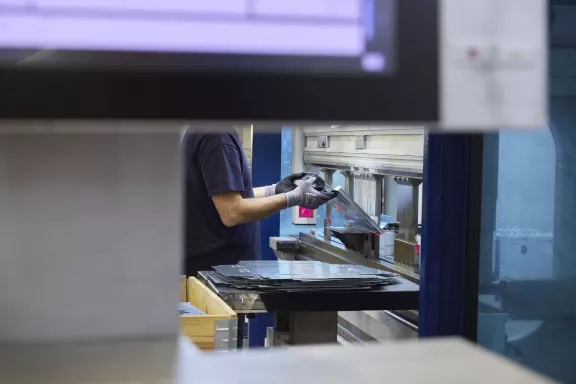
In the case of sheet metal, this may include checking dimensions after cutting, verifying bend angles, checking hole positioning, aligning components, or verifying the compliance of parts intended for assembly.
In-process inspections are essential because they allow timely intervention, reducing the risk that any errors will carry through to the final stage.
Final Inspection
Final inspection verifies that the finished component complies with the agreed specifications. It may include dimensional checks, visual inspections, functional checks, and compliance checks against the technical drawing.
This phase validates the result before delivery, but it only has full value when included within a broader quality system. Final inspection alone is not enough: it must be the outcome of a process that has already been monitored during its main stages.
Production Start-Up Inspection
In industrial production, production start-up inspection plays a strategic role. It verifies not only that the component manufactured at the start of production complies with the technical drawing and the required specifications, but also that production remains within the established tolerances and requirements.
Production start-up inspection is performed on a sample, with the sample size defined together with the customer. This sample size must be significant because it must represent the entire population, meaning the entire production run. Once this has been established, the Statistical Process Control techniques mentioned above can be implemented, along with Cp/Cpk capability analysis and, where required during production, Control Charts.
This inspection is particularly useful when moving from prototyping or pre-series production to actual production. Production start-up inspection makes it possible to check dimensions, bends, holes, mating features, and functional characteristics before proceeding with the entire batch.
If critical issues emerge, action can be taken on the process, tools, processing parameters, or production sequence before the error is repeated across a larger number of components.
Assembly and Integrated Fabrication: When Quality Applies to the Entire Product
In the case of complex metal components, quality does not concern only the individual part, but the entire assembly.
A component may comply with its own dimensional requirements but still present issues if it is not consistent with the other elements with which it must be assembled. For this reason, when discussing assembly and integrated fabrication, quality control must consider the product as a whole.
Minifaber is able to manage integrated sheet metal fabrication, overseeing not only the individual production stages but also the relationship between the different components. This approach is important when the customer needs a partner capable of managing multiple operations and guaranteeing a consistent final result.
From Design to Delivery: The Minifaber Method
Minifaber’s value lies in its ability to support the customer throughout the entire production process. This makes it possible to maintain more effective control over the project and integrate quality, technology, and technical expertise.
The Minifaber method includes several stages. It begins with the initial analysis of project specifications and the assessment of production feasibility. It then moves on to the selection of the most suitable process and the implementation of the different manufacturing operations. The team also carries out checks on dimensions and compliance.
This approach is particularly useful for companies looking for a partner capable of going beyond simple execution. Minifaber does not merely manufacture parts; it contributes to the overall quality of the project by providing experience, technology, and method.
Why Choose Minifaber for Controlled and Reliable Sheet Metal Fabrication
Choosing Minifaber means relying on a partner specialized in sheet metal fabrication and the production of custom metal components, with an ISO 9001:2015 certified quality system and an approach focused on process control.
Quality is managed in an integrated way: from technical drawing assessment to the selection of manufacturing operations, from dimensional inspections to final component verification. This makes it possible to ensure greater reliability, reduce the risk of nonconformities, and support the customer even in the most complex projects.
When quality, control, and production work together, the result is not just a compliant part. It is a reliable component, designed to function properly within the system in which it will be used.
Do you need to manufacture sheet metal components with specific requirements for quality, dimensional control, and production reliability?
Contact Minifaber: the technical team can support you from the design stage, helping you evaluate materials, processes, tolerances, inspections, and the most suitable production solutions for your needs.