Runways for Automated Storage Systems: Sheet Metal Fabrication for Logistics Automation
Logistics has undergone a profound transformation in recent years. E-commerce growth, rising order volumes, and the demand for faster delivery times have pushed companies to fundamentally rethink how they store and move inventory.
At the center of this shift are automated warehouses, facilities that can rise dozens of meters high, house thousands of storage locations, and operate almost entirely without human intervention, powered by fleets of robots that run around the clock.
Behind the visible automation, though, sit mechanical components that make it all possible. One of them is the runway: the metal track that guidance robots travel along to reach storage positions.
It's a component that rarely shows up in the marketing materials for logistics automation systems, yet it's one of the technical conditions their performance depends on entirely.
What Are Automated Storage Systems, and Why Are They Growing?
A modern automated warehouse runs on a different logic than a traditional one. Instead of sending an operator to search the aisles for inventory - the classic man-to-goods model - the system itself brings the goods to the operator or pick station. In the industry, this is called goods-to-person.
This paradigm shift has been driven by AS/RS (Automated Storage and Retrieval Systems): stacker cranes, shuttle systems, and mini-load units that move through high-density racking, often across multiple stacked levels.
These systems deliver optimal use of vertical space, fewer picking errors, full traceability of load units, and 24/7 operation with no downtime tied to shift changes.
It's no surprise that the sectors benefiting most from this technology are the ones with high volumes and tight margins for error: e-commerce, large-scale retail distribution, food and beverage, and industrial assembly, where pick speed and accuracy directly impact final delivery times.
At the operational level, a shuttle system relies on robotic carriers that travel along dedicated aisles within the racking structure, picking up and depositing load units on command from a warehouse management system (WMS).
Each shuttle communicates with the central system, which optimizes routing and pick priorities in real time. It's a complex orchestration of hardware and software - one that rests, physically, on metal structures machined to millimeter precision.
Stacker Cranes, Shuttles, and Mini-Load Systems: Not All AS/RS Are Built the Same
The label "automated warehouse" covers several distinct technologies, each engineered for specific storage and handling needs. Stacker cranes are among the most widely used solutions for high-volume storage; shuttle systems offer greater configuration flexibility; mini-load systems are built for handling smaller containers.
Each configuration responds to different requirements around available space, SKU count, and throughput frequency.
What all these technology families have in common is their dependence on supporting metal structures, including runways that must deliver the same dimensional precision regardless of how complex the robotic system riding on them is. No matter how advanced the management software or onboard sensors are, no robotic system can compensate for a track that falls outside design tolerances.
Runways: The Component the Robots Ride On
Runways are exactly that: the metal tracks that guide shuttle robots through the racking structure. In a large-scale automated warehouse - with structures that can exceed thirty or forty meters in height and hold thousands of storage positions - runways extend for dozens of linear meters, often across multiple stacked levels.
What makes this component critical isn't geometric complexity, it's dimensional repeatability. A robot running on a runway has zero tolerance for misalignment. Even a minimal variation in the track's cross-section, repeated over tens of meters, can translate into abnormal friction, vibration, or, in the worst cases, a full stop of the handling system. In a warehouse running 24/7 without continuous human oversight, that's not a minor technical glitch, it's a shutdown of the entire logistics flow, with direct consequences for order fulfillment times.
For this reason, manufacturing runways demands a level of dimensional precision comparable to precision mechanical components, even though the part itself is structurally simple in form. The challenge isn't designing a complex geometry but it's guaranteeing that exact geometry repeats identically across thousands of parts and considerable lengths, batch after batch.
How They're Manufactured: Transfer Stamping on High-Strength Pre-Galvanized Steel
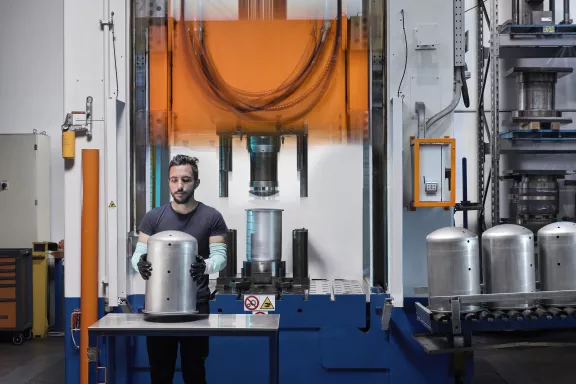
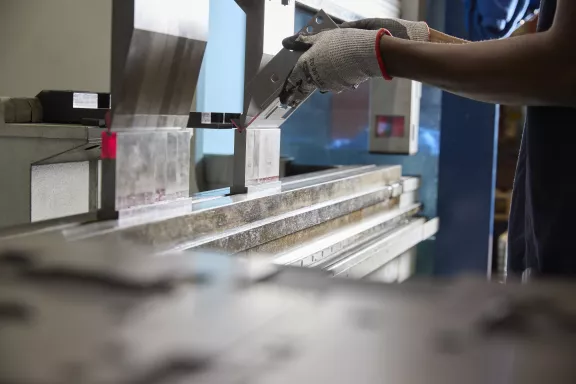
To meet these requirements, Minifaber manufactures runways through a transfer stamping process on high-strength pre-galvanized steel. This technology integrates multiple operations - bending, blanking, and cold forming - into a single automated cycle, steps that other manufacturing processes would require on separate machines.
The main advantage of transfer stamping is its ability to sustain high-volume production while keeping costs competitive against other sheet metal fabrication methods. By consolidating multiple stages into one automated sequence, Minifaber reduces part handling between operations, directly benefiting both cycle times and dimensional repeatability — the single most critical requirement for this type of component.
The choice of high-strength pre-galvanized steel isn't incidental, either. Automated warehouse structures are built to stay in service for years, often in industrial environments with continuous exposure to moisture and dust. Galvanizing applied upstream of fabrication provides corrosion protection that lasts the component's entire service life, with no additional surface treatment required after forming. The high-strength grade gives the steel the structural robustness to handle loads without failure or breakage — and the plant downtime that would follow.
Why Choose Minifaber for Logistics Automation
When a project calls for series production of components like runways, choosing a supplier isn't just about the ability to machine a single part to spec. It requires a transfer die engineered specifically for that geometry, a machine fleet capable of sustaining high-volume output without losing precision over time, and a preventive validation process that catches dimensional issues before they propagate across thousands of identical parts.
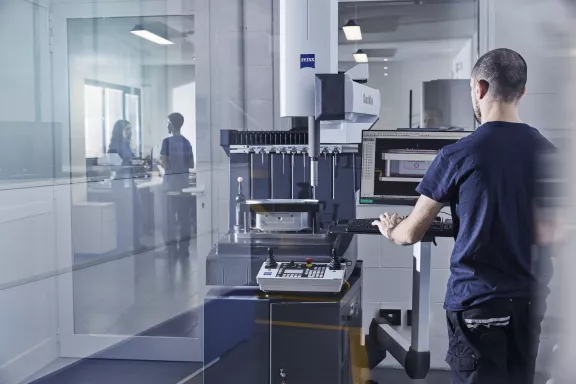
Minifaber develops validated sample runs with the client before full production launch, verifying process capability through Cp and Cpk statistical indices.
Production is then monitored using the most advanced process control systems available: starting from the Control Plan, through physical inspections defined in the control sheets, to final data logging and statistical analysis.
For Minifaber, the added value lies in managing the entire production cycle in-house — from transfer die design to series production — with a single point of contact for the full supply chain. That means one technical specification, one validation process to coordinate, and unbroken traceability across the supply chain: a concrete advantage for anyone designing logistics automation systems who doesn't want to manage multiple suppliers for a component that looks simple but is technically critical.
As logistics automation continues to grow in the coming years, demand for reliable structural components — produced at scale and at competitive cost — will grow right alongside it.
Have a project that requires sheet metal components for logistics automation?
Contact Minifaber: our technical team can support you from the design phase onward, helping evaluate materials, processes, tolerances, and the production solutions best suited to your needs.